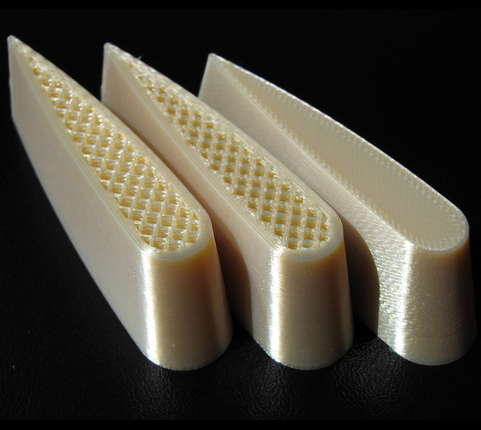
ULTEM 9085 is a high strength thermoplastic that is certified by the Federal Aviation Administration (FFA) for additive manufactured (AM) parts. This qualification was conducted by the National Institute for Aviation Research (NIAR) and analyzed by the National Center for Advanced Materials Performance (NCAMP). The qualification data includes mechanical properties such as tensile and flexural loading as well as physical & chemical properties such as flammability and moisture loss. The goal of our current study is to analyze the NCAMP database to find abnormal performance and develop testing plans to explore these findings. The initial testing conducted last year focused on tensile properties of ULTEM 9085 and exploring how build orientation effects the density of parts and interlayer bonding. The testing that is currently being conducted explores different geometries and ASTM testing procedures for compression, V-notch shear, and single shear bearing coupons. The goal of this testing is to produce more appropriate failure modes. Along with this further tensile testing is being conducted exploring the effect that the number of contours have on the mechanical properties of different build orientations. Further testing later this spring plans on developing a machine learning model to predict the stress strain curve based on process parameters such as infill percentage, raster angle, and build orientation.
ASTM D 3762, ”Standard Test Method for Adhesive-Bonded Surface Durability of Aluminum (Wedge Test)”
• Bonded aluminum double cantilever beam specimen is loaded by forcing a wedge between the adherends
• Wedge is retained in the specimen
• Assembly placed into a test environment
– Aqueous environment
– Elevated temperature
• Further crack growth is measured following a prescribed time period
– Sandwich disbond test standards supporting the ongoing CMH-17 efforts for Rev. H
– Evaluation of analysis used by industry for Category 2 and 3 large in-plane damage
capability of sandwich structures, including complex structural loading
– Development of building block test standards & related data analysis procedures to
gain the structural data needed to support sandwich structural damage tolerance
This is a Boeing-funded project though the AMTAS center, involving shear lap coupons exposed to hot water and creep stress. We have examined the failure surfaces of the adhesive using SEM. The failure was dominated by adherend failure at the fiber interface, the portion is which increased slightly with moisture content.
To ensure the longevity of the commercial aircraft fleet, the long term durability of primary aircraft structure must be understood. The degradation of metals and their attachments (mechanical and adhesive) has been rigorously studied over the years. The introduction of composite materials in aerospace applications has presented challenges as methodologies that have successfully been used for metals do not always produce reliable results with new materials. This project will consider the effect of surface treatments on composite adherends and accelerated test methods that may be used to reliably compare their long term degradation. Follow-on projects will consider improving durability using nano-reinforced adhesives.
An accurate and efficient analysis method is critically needed for the damage tolerant design of bonded composite structures. In this proposal, sponsored by Boeing research and Technology, a technical approach to the disbond/delamination arrest problem has been presented. Major tasks to be accomplished during the six months period have been identified and discussed. These tasks include: development of analytical capability for the analysis of disbonds and delaminations as well as performing sensitivity studies on the effects of stacking sequence and the fastener dimensions and properties. Results of this research will contribute directly to the integrity and safety of aircraft structures made of bonded materials.
Many structural elements external to the fuselage of transport aircraft are produced using polymer sandwich honeycomb composites; composite rudders or ailerons, for example. These components experience the environmental extremes typical of Class A airspace. In particular, temperatures at altitude often fall to -50ºC or below. Meanwhile, it has been shown that the humidity within the core region of a polymer honeycomb panel will slowly increase with time due to exposure to typical terrestrial humidity levels. Although immediately after production the internal core humidity level of sandwich composites is normally low (perhaps approaching zero humidity), over time water molecules diffuse through otherwise undamaged gelcoat and composite facesheets, slowly increasing internal humidity levels. If internal humidity becomes high enough then internal water vapor may condense and freeze within the core while the aircraft is at altitude. This implies that a condense-freeze-thaw-evaporate cycle may occur within a sandwich structure during the normal duty cycle of a commercial transport aircraft. The objective of this study is to determine if this condense-freeze-thaw-evaporate cycle leads to internal damage that may be detrimental to the mechanical performance of honeycomb sandwich structures. Specifically, the bending stiffness and mode I strain energy release rate (GIc) of honeycomb composites will be measured, under four conditions:
- as-produced (dry),
- following thermal cycling from room temperatures to -50 ºC under dry conditions,
- following exposure to 70%RH and 50%C for several months, and
- following exposure to 70%RH and 50%C for several months as well as thermal cycling from room temperatures to -50 ºC.