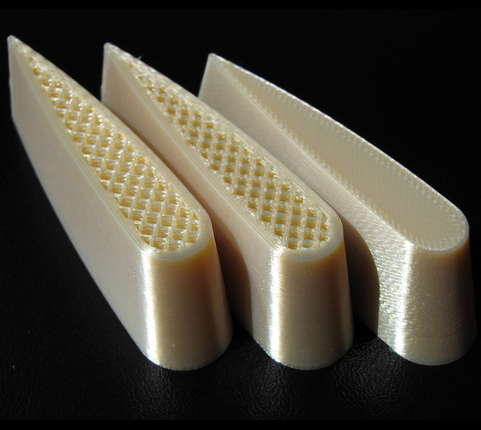
ULTEM 9085 is a high strength thermoplastic that is certified by the Federal Aviation Administration (FFA) for additive manufactured (AM) parts. This qualification was conducted by the National Institute for Aviation Research (NIAR) and analyzed by the National Center for Advanced Materials Performance (NCAMP). The qualification data includes mechanical properties such as tensile and flexural loading as well as physical & chemical properties such as flammability and moisture loss. The goal of our current study is to analyze the NCAMP database to find abnormal performance and develop testing plans to explore these findings. The initial testing conducted last year focused on tensile properties of ULTEM 9085 and exploring how build orientation effects the density of parts and interlayer bonding. The testing that is currently being conducted explores different geometries and ASTM testing procedures for compression, V-notch shear, and single shear bearing coupons. The goal of this testing is to produce more appropriate failure modes. Along with this further tensile testing is being conducted exploring the effect that the number of contours have on the mechanical properties of different build orientations. Further testing later this spring plans on developing a machine learning model to predict the stress strain curve based on process parameters such as infill percentage, raster angle, and build orientation.
Contributed to composite crashworthiness (a) experimental database, (b) analysis methods, and (c) certification protocols that were developed and ultimately adopted by Boeing and used during certification of the B-787.
Motivation and Key Issues
• The matrix-compression material-model used in Abaqus for carbon fiber laminates is computationally efficient but is physically unrealistic and does not correspond to actual material behavior.
Objective
• Determine the conditions under which the use of this unrealistic material model causes significant errors in predictions of carbon fiber
laminate response to load and load-carrying ability.
Approach
• Conduct experimentation to determine a physically-correct matrix-compression material model
• Implement this material model in Abaqus and compare its predictions with those of the currently-used material model
The purpose of this proposal is to develop a new design approach to quantify the reliability of aerospace structures. In this approach, the “Level of Safety (LOS) of an existing structural component is determined based on a probabilistic assessment of in-service accumulated damage and the ability of non-destructive inspection methods to detect such damage. Specifically, the discrete LOS for a single inspection event is defined as the compliment of the probability that a single flaw size larger than the critical flaw size for residual strength of structure exists, and that the flaw will not be detected. The cumulative LOS for the entire structure is the product of the discrete LOS values for each damage type Present at each location in the structure. This approach can be utilized to develop a design process which evaluated the equivalent LOS of an existing structure, and use this value in the design of a new structure which matches or exceeds the existing LOS value. The LOS method enables the characterization of uncertainty associated with damage accumulation, inspection reliability and residual strength of the structure.
We propose to the FAA to develop analytical, computational and experimental capabilities to address “Combined Global/Local Variability and Uncertainty in Integrated Aeroservoelasticity of Composite Aircraft”. Computational capability development will focus on quantification of effects on stiffness of key local effects in composite structures, global aeroelastic/aeroservoelastic analyses capable of evaluating variations and uncertainity to such local effects, and integrated local/global modeling capability of uncertain composite structures. Capabilities for simulation of the effects of control surface nonlinearities on aeroelastic and aeroservoelastic behavior of full scale airplanes will be developed and used to study effects of nonlinearity and uncertainty mechanisms and guide maintenance practices. Simultaneously, an experimental structural dynamic/aeroelastic testing capability will be developed at UW, and tests will be planned & conducted to study the effects of damage on stiffness of components and models.
The primary objective of the proposed work is to verify the reliability and sensitivity of solid-state electrochemical sensors for detecting surface contaminants and moisture on pre-bond surfaces. Sensors, made using the novel concepts applied to solid-state electrochemical materials, were found to be very sensitive in experiments with polyester peel ply samples. However, the method has not been tested for other peel ply samples that may have more or less contamination and/or moisture levels. In addition, the correlation between the features of the signals and surface chemistry condition has not been established. The proposed work will be focused on comprehensive testing and evaluation of the sensors. The proposed work will also be focused on atomic force microscopy (AFM) and chemical force microscopy (CFM) analysis of the sample surfaces prepared with peel ply.